
Guides
November 9, 20269 min read
Bipolar Outpatient Treatment: PHP, IOP, or Weekly Care
After a hospital stay, a medication change, or a few weeks of slipping, you'll see which outpatient level fits.
Rize OCRead
Same-day assessments · Orange County, CA
Rize OC
Editorial Team
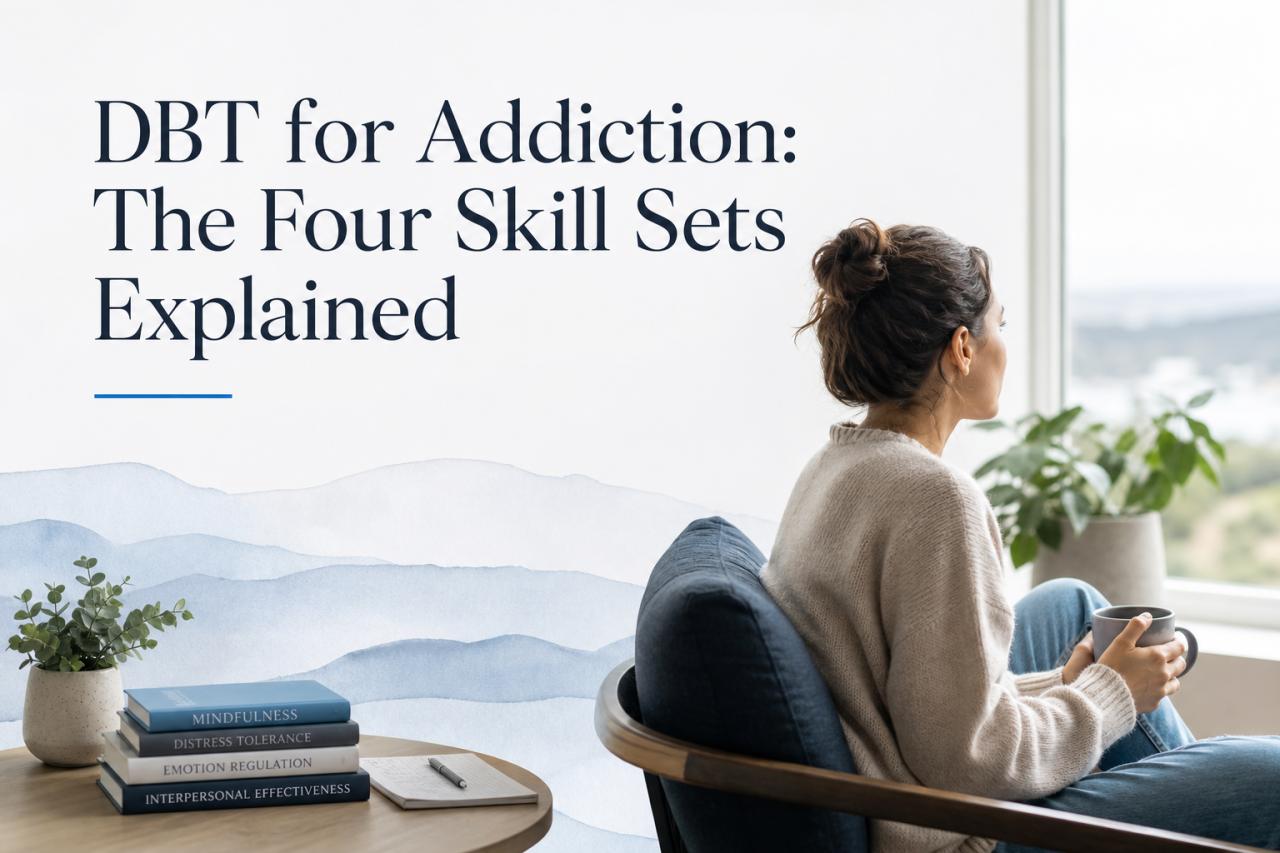
DBT for addiction gives you four practical skill sets (mindfulness, distress tolerance, emotion regulation, and interpersonal effectiveness) that you rehearse in group and then use during cravings, arguments, and hard nights. It was built to help people sit through intense feelings without acting on them. Rize OC teaches these skills alongside other methods, and a clinical assessment sets the mix.
If you're thinking about suicide or hurting yourself, call or text 988 (Suicide & Crisis Lifeline). If you're in immediate danger or think someone has overdosed, call 911.
Marsha Linehan, a psychologist at the University of Washington, developed dialectical behavior therapy in the late 1980s and early 1990s, first for adults with chronic suicidal thoughts and borderline personality disorder. "Dialectical" means holding two things at once. You accept yourself as you are, and you work to change specific behaviors. Clinicians later adapted the approach for people with substance use disorders, because intense emotion and impulsive action often drive the cycle of use. Our page on borderline personality disorder covers that diagnosis if you want background.
Addiction programs use DBT skills because cravings, shame, and conflict at home tend to hit before a person has time to think. The skills give you something specific to do in that gap. The National Institute on Drug Abuse describes behavioral therapies as a core part of addiction treatment, helping people change attitudes and build coping skills (NIDA, Principles of Drug Addiction Treatment). SAMHSA also lists DBT among the evidence-based psychotherapies used for co-occurring mental health and substance use conditions.
In practice, you learn one skill at a time in a small group, take it home, and report back on how it went. Expect handouts or worksheets, short practice exercises during the session, and plain questions about where a skill helped and where it didn't. Rize OC uses DBT skills alongside CBT, motivational interviewing, and relapse-prevention planning. A licensed clinician sets that mix after your assessment, and it can change as your needs do.
Each of the four skill sets covers a different kind of moment, and most people find one or two come easier than the others at first.
Mindfulness is the base for the rest. You practice noticing a thought, a body sensation, or an urge without reacting right away, usually through short exercises like a guided breathing minute or naming what you feel in your body. A craving is easier to ride out once you can see it as a wave rather than an order.
Distress tolerance is for the moments when a problem can't be fixed right now. The skills include changing your body chemistry with cold water or paced breathing, distracting yourself on purpose, and soothing yourself through the senses. They get you through a bad hour without making it worse.
Emotion regulation works earlier in the chain. You learn to name emotions accurately, notice what sets them off, and look after the basics that make feelings harder to manage, such as sleep, regular meals, and movement. The goal is fewer emotional spikes that end in use.
Interpersonal effectiveness covers how you ask for what you need, say no, and protect a relationship without giving up your recovery. Groups often role-play a hard conversation, so the words feel familiar before you need them.
Rize OC's clinicians teach these inside group sessions rather than as a separate program, and your therapist can point you toward the ones that fit your triggers. You'll usually get a worksheet or card to take home for practice between sessions.
Picture a Friday at 6 p.m. after a rough week, with a bottle or a dealer's number a few taps away. Each skill set meets that moment differently, and the examples below are general ones, not a client's story.
With mindfulness during a craving, you stop and name what's happening: "I'm having an urge, my chest is tight, and my thoughts are racing." Naming it separates the urge from the decision. You then watch it rise and fall for a few minutes before choosing what to do.
On a hard night, say you've just gotten bad news and can't fix it before morning. Distress tolerance might mean holding a cold pack to your face, breathing out longer than you breathe in, or calling a friend and talking about anything else. The aim is to reach morning without adding a new problem.
Emotion regulation works before the spike. If Sunday evenings bring dread about work, you plan for it with a real dinner, a walk, and an on-time bedtime, so the dread doesn't build into a night of using.
In an argument, say a family member brings up your past and the conversation heats up. Interpersonal effectiveness gives you a short script. State the facts, say how you feel, ask for one specific thing, and hold your boundary if the answer is no. For instance, "I can't talk about this right now, and I'd like to pick it up tomorrow."
Most people don't get these right on the first try. Your group leader will ask what you tried, what happened, and what to adjust, and that feedback is where the learning happens.
CBT asks you to question a thought and change it, while DBT asks you to accept what you feel in the moment and then change what you do. Say you think, "I've ruined everything, so I might as well use." In a CBT session, you'd examine that thought, weigh the evidence for and against it, and write a more accurate one. In a DBT skills group, you'd first practice getting through the surge of shame with paced breathing or a cold pack, then decide what to do next.
CBT focuses on the link between thoughts, feelings, and behavior. DBT adds the dialectical idea that acceptance and change work together. It also spends more time on emotional intensity and on relationships, which is why interpersonal effectiveness is its own module.
You don't have to pick one. At Rize OC, DBT skills and CBT sit in the same treatment plan, and your clinician may lean on CBT for thought patterns that keep returning and on DBT skills for moments when emotion hits too fast to reason through. A clear thought is easier to reach once your body has calmed down.
It's fine to ask your therapist which tool they're using in a given session and why. The answer helps you practice the right skill at home.
In the Partial Hospitalization Program, DBT skills sit inside a structured daytime schedule, and you go home or to sober living in the evening. That gives you a built-in practice window. You learn a skill in group, use it that same night, and bring the result back the next day. Afternoons rotate experiential programming such as art therapy, somatic movement, meditation, and yoga, which give you more chances to practice staying with a feeling in your body. Psychiatrists are embedded in PHP, so medication questions can be raised alongside the skills work.
The Intensive Outpatient Program runs about 3 to 9 hours of clinical time a week, with morning and evening tracks so treatment can fit around a job or family. Groups have eight clients or fewer, and you also meet weekly with an individual therapist. Skills groups are one part of that week, and your individual sessions are where you and your therapist check which skills are holding up. Because the gap between sessions is longer than in PHP, you'll lean more on worksheets and cards you carry with you.
Both levels use DBT skills next to CBT, motivational interviewing, and relapse-prevention planning. Where you start depends on your clinical assessment, which looks at withdrawal risk, mental health, safety, home support, and daily responsibilities. If you also have anxiety, depression, or trauma symptoms, our dual diagnosis care treats those and substance use in one plan, so the skills you practice fit both.
Many people step down from PHP to IOP as they stabilize, and the skills they've rehearsed come with them.
Skills groups can't carry the full load when withdrawal is a medical risk, when thoughts of self-harm keep returning, or when a mental health condition needs its own treatment. Someone who drinks heavily or uses benzodiazepines or opioids every day can face dangerous withdrawal, and that calls for a medical evaluation before any group work starts. The National Institute on Drug Abuse notes that medically managed detox is only the first stage of treatment and doesn't treat the addiction itself.
Rize OC doesn't provide on-site detox. If you need 24-hour stabilization first, our admissions team will say so plainly and help coordinate placement, then bring you back to outpatient care when it's safe.
Skills groups also work best alongside other care for trauma symptoms, which may need EMDR with a licensed, EMDR-trained therapist or trauma-focused CBT. The same goes for depression, bipolar disorder, or severe anxiety that may call for psychiatric medication management, and for a home where staying in recovery is hard every evening.
If a licensed prescriber decides medication is appropriate, talk with that prescriber or your pharmacist about any questions. Medication decisions stay with them.
A clinical assessment sorts this out. A licensed clinician looks at withdrawal risk, mental and physical health, safety, home support, and your daily responsibilities, then recommends a level of care. The assessment is confidential and carries no obligation. If the best fit is more structure than you expected, you'll hear that, along with the reasons.
To talk it through, call Rize OC at (949) 461-2620. If you'd rather check coverage first, you can verify your insurance online, and we'll confirm your benefits before care begins. Coverage varies by plan.
About the Author
Helpful educational resources from Rize OC.
In This Article
Topics
Ready for Help?
Confidential support, same day.
After a hospital stay, a medication change, or a few weeks of slipping, you'll see which outpatient level fits.
Winter low moods and heavier drinking or drug use often overlap. Here's how outpatient therapy and IOP differ and what an assessment at Rize OC covers.
No medication is approved for cocaine use disorder, but reward-based treatment paired with CBT has a clear structure.
Take the Next Step
If you or a loved one is struggling with addiction or mental health, the Rize OC team is here to help — confidentially and with no obligation.