

Guides
October 15, 202612 min read
Returning to a High-Stress Career After Dual Diagnosis Care
A practical framework for protecting aftercare, managing work stressors, and responding early when warning signs appear.
Rize OCRead
Same-day assessments · Orange County, CA
Rize OC
Editorial Team
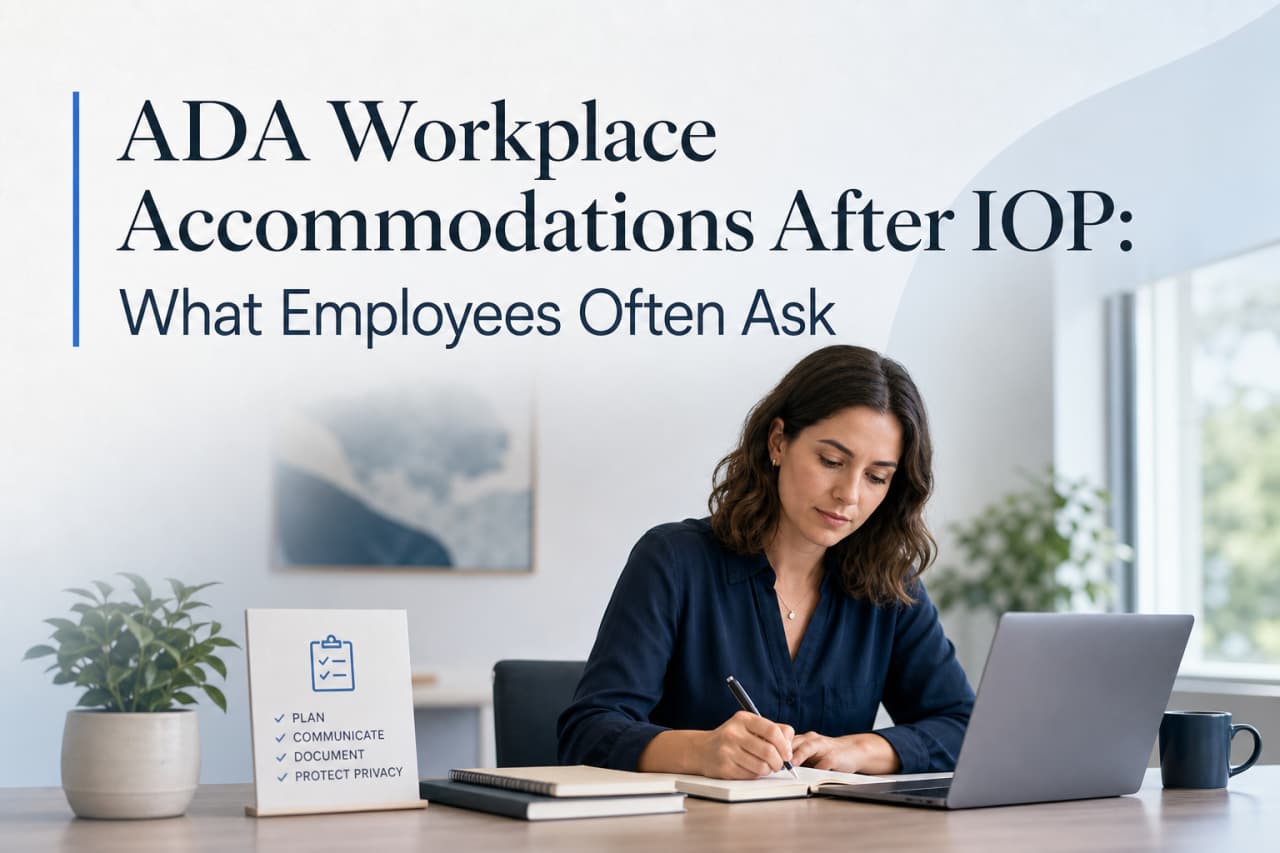
You can ask for a work change before your first day back. The ADA does not require a special form or the words reasonable accommodation. A request may cover a modified schedule, leave for continuing care, or a shift in noncore tasks. Eligibility turns on your disability, your job duties, and the burden on the employer. The examples below are educational and are not legal or medical advice.
Finishing an intensive outpatient program, or IOP, does not by itself create ADA coverage. The real tests are whether you have a qualifying disability, whether you can perform the essential job functions with or without an accommodation, and whether the change you want is reasonable. Federal and California rules can differ. Use this framework to prepare a conversation, not to decide your legal rights on your own.
A strong request ties a concrete work barrier to a change that would fix it. Asking for less stress gives an employer almost nothing to evaluate. Asking for a fixed shift during continuing treatment names what must change, why it helps, and how long you expect to need it. A sensible starting point is the narrowest option that still lets you do your core duties.
Federal ADA rules generally cover private employers with 15 or more employees. California law reaches smaller workplaces. The California Civil Rights Department states that state disability accommodation rules generally cover employers with five or more employees. Public jobs, union contracts, and local rules can add more requirements.
| Work barrier | Accommodation to discuss | Details to define |
|---|---|---|
| Continuing appointments conflict with your shift | Adjusted start or end time, a fixed appointment block, or intermittent leave | Affected days, expected duration, notice process, and how missed work will be handled |
| Temporary limits in concentration or stamina | Short additional breaks, a quieter workspace, or fewer noncore interruptions | Break frequency, coverage needs, and the work you can still complete |
| An immediate full schedule creates a functional barrier | A phased return or temporary part-time schedule | Proposed hours, review date, and a possible path back to the regular schedule |
| Rotating shifts interfere with continuing care | A temporary fixed shift or advance schedule notice | The shift requested, length of the change, and effects on team coverage |
| Some duties can be completed away from the worksite | Temporary remote or hybrid work | Tasks performed off-site, communication plan, security needs, and required on-site duties |
| A noncore task creates a disability-related barrier | Job restructuring or reassignment of that task | Which duties are core to the role and which duties could move to another employee |
These are talking points, not automatic rights. Your employer may propose another effective option. It usually does not have to drop a core duty or invent a new job. The Equal Employment Opportunity Commission's accommodation guidance covers how employers weigh effectiveness, undue hardship, job restructuring, leave, and reassignment.
Begin with the work rule that creates the barrier. A diagnosis alone does not tell an employer why anything must change under federal ADA rules for workplaces with 15 or more employees, or under California rules that can reach employers with five or more. Attendance, shift timing, travel, concentration demands, customer contact, and physical presence are the requirements that often matter. Write down what you can do, what you temporarily cannot do, and which change would let you finish the work.
Review your job description, normal schedule, attendance rules, and current performance expectations. Identify the functional limitation affecting a specific task or schedule requirement, then choose one requested change and one workable alternative. State when the accommodation should begin and whether the need is temporary, ongoing, or uncertain. Propose a review point so you and your employer can assess whether it works, and ask where medical documentation should be sent before sharing private records.
For example, say an employee has a continuing appointment every Tuesday afternoon for eight weeks. A usable request might propose an earlier start and end on Tuesdays, note that the same scheduled hours still get worked, and offer intermittent leave as a backup if the shift cannot move. An employer can review that far faster than a vague ask for flexibility.
A review date helps when long-term needs are still unclear at discharge. That date does not waive your rights or lock the accommodation to a hard stop. Both sides get a set time to talk through attendance, workload, treatment scheduling, and any new paperwork. For people returning to work in Orange County, that structure keeps the immediate reentry plan separate from choices that can wait.
Ask your treatment provider about functional limits before you request a workplace change. Your employer needs to know how the medical condition affects work. Your provider needs accurate details about the job.
Your employer may ask for reasonable documentation when the disability or the need for a change is not obvious. The EEOC's accommodation guidance focuses the ask on whether a covered impairment exists, what work limit it causes, and why the proposed change would address that limit. A full treatment chart rarely answers those points better than a focused provider letter.
| Information that may support the request | Information that may be broader than needed |
|---|---|
| Confirmation of a medical impairment when coverage isn't apparent | Every diagnosis in your medical history |
| The functional limitation affecting work | Detailed therapy notes or personal treatment discussions |
| The connection between the limitation and requested change | Records unrelated to the accommodation request |
| Expected duration or a date for reassessment | An unrelated medication history |
| Provider credentials and contact information | A full copy of your treatment chart without a stated reason |
Ask human resources which facts are still missing before you sign a broad release. A provider letter can name the restriction, state its expected length, and explain what the accommodation does without a detailed account of IOP. If the employer hands you a form, read each authorization and ask where the form will be kept.
A plain-language request can say: “Because of a medical condition, I am requesting a workplace accommodation. I am asking for [change] beginning [date] because a functional limitation affects [task or schedule]. I can provide documentation about the limitation and need.”
Substance use disorder requests carry another legal line. Current illegal drug use is not protected when an employer acts because of that use. A person who is not currently using illegal drugs and who has completed or is in supervised rehabilitation may have ADA protection. Current has no fixed day count, and it depends on the facts. The U.S. Department of Justice offers more context in its ADA guidance on opioid use disorder.
An employer may still bar alcohol or illegal drugs at work and enforce conduct or safety rules. Taking prescribed medication as directed is not the same as illegal drug use under the ADA, though job-related safety issues can allow limited questions. Get legal advice if drug testing, medication disclosure, or a safety-sensitive role affects your request.
The legal basis sets the process. A manager may approve an ordinary schedule change under workplace policy with no medical paperwork. An ADA request links a workplace change to disability and can apply at private employers covered by the federal 15-employee threshold or California's five-employee rule. Medical leave may sit under the ADA, the Family and Medical Leave Act, California law, employer policy, or more than one of those at once. Each path has its own eligibility and documentation rules.
| Option | What it does | What to check |
|---|---|---|
| Routine schedule request | Changes hours under the employer's normal scheduling policy | Manager authority, staffing rules, and whether medical information is needed |
| ADA accommodation | Changes a workplace rule, schedule, task, or location because of disability | Disability coverage, job duties, effectiveness, documentation, and employer burden |
| Medical leave | Provides time away from work for treatment or incapacity | Job protection, available paid time, benefit rules, certification, and return procedures |
| Intermittent leave | Provides separate blocks of leave for appointments or episodic limitations | Notice requirements, scheduling options, certification, and timekeeping |
| Return-to-work restriction | Tells the employer what your provider says you can or can't do | Whether a workplace change can address the restriction without removing a core duty |
Federal FMLA can give job-protected leave to eligible employees at covered employers. Eligibility turns on employer size, time on the job, hours worked, and worksite staffing. The U.S. Department of Labor's FMLA resource lays out the federal rules. California employees may also hold state-law rights. Treat the programs as separate systems, not interchangeable ones.
ADA leave is generally unpaid unless an employer policy or another law supplies pay. Health coverage during leave also depends on the governing law and plan terms. Ask human resources which leave bank will be charged, whether benefits continue, how premiums are paid, and what happens if the return date moves. Get those answers in writing before you rely on a verbal yes.
An employer can reject a specific request if it would cause undue hardship, strip a core duty, or leave you unable to do the job. The employer may also decide you are not covered by the ADA or not qualified for the role. A direct-threat finding should rest on a case-specific review under EEOC standards, not fear or assumptions about mental health or substance use treatment. The California Civil Rights Department enforces parallel state rules for many workplaces with five or more employees.
A no on your preferred option does not always close the file. The employer may offer another effective change. If remote work would block an on-site duty, a fixed schedule or intermittent leave might still solve the same treatment conflict. Ask why the first option failed and which alternatives the employer weighed.
Medical information collected in the accommodation process must generally stay confidential and out of ordinary personnel files. A supervisor may need your work restrictions or approved schedule. That does not mean the supervisor needs your diagnosis, treatment history, or reason for attending IOP. Limited disclosure can be allowed for first aid, safety, insurance, or government compliance.
Send medical documents only to the person or department assigned to receive them, and keep copies of your request, supporting documents, proposed alternatives, and employer responses. Ask for the reason in writing if the request is delayed or denied, and correct missing or unclear documentation promptly. Speak with an employment attorney, the EEOC, or the California Civil Rights Department if the process stops or discrimination is involved.
An accommodation usually runs forward from approval. Employers may still apply job-related performance, attendance, and conduct rules. An approved change may not wipe out prior discipline that was lawful. Make the request as soon as you see a disability-related barrier, and document shifts in your condition or schedule so the request can be updated when needed.
You generally do not have to volunteer your full treatment history just because you are coming back to work. If you request an accommodation, you need to give the employer enough detail to see that a medical condition affects work. Human resources may then ask for documentation. You can usually stay focused on functional limits and the requested change instead of sharing treatment details with your direct supervisor.
No. IOP participation alone does not decide ADA coverage. The legal analysis looks at the impairment, how it affects major life activities, your ability to perform the job, and the accommodation requested. A record of a qualifying disability can also matter. Current illegal drug use has separate rules, so a person with a substance use disorder may need advice based on the specific facts.
Yes, you can request it. Approval still depends on your job and the barrier you need fixed. Explain which tasks can be done remotely, which duties require your presence, and how you would stay in contact with the team. If full remote work is not workable, a temporary hybrid schedule, adjusted hours, or leave for continuing appointments may still address the conflict.
Yes. An employer can pick another effective accommodation even when it is not your first choice. Explain why an alternative does or does not address the functional limitation. A preference based only on convenience usually carries less weight than a provider-supported explanation showing that the alternative leaves the work barrier in place.
Ask for a status update and name the next required action. Confirm whether the employer still needs documentation, a different proposal, or time to review operations. Keep the exchange in writing. Filing deadlines can apply to legal claims, so reach the EEOC, the California Civil Rights Department, your union representative, or an employment attorney promptly if you believe your rights were violated.
Write down the exact work barrier, your preferred change, one alternative, and the date you need an answer. Then ask human resources for the employer's accommodation procedure and documentation form. Hold treatment records private until you know what information is required and where it should go.
If you are planning work reentry after IOP and want to talk through Rize OC's services, reach our team through the Contact Us page at https://rizeoc.com/contact-us. We can discuss next steps without promising workplace approval, insurance coverage, or treatment outcomes.
About the Author
Helpful educational resources from Rize OC.
In This Article
Topics
Ready for Help?
Confidential support, same day.
A practical framework for protecting aftercare, managing work stressors, and responding early when warning signs appear.

A family checklist for spotting substance-related decline behind steady employment and deciding when to request an assessment.

Practical points on requesting treatment leave, protecting your privacy, and where Rize OC outpatient care in Lake Forest fits.




Take the Next Step
If you or a loved one is struggling with addiction or mental health, the Rize OC team is here to help — confidentially and with no obligation.