

Guides
October 15, 202612 min read
Returning to a High-Stress Career After Dual Diagnosis Care
A practical framework for protecting aftercare, managing work stressors, and responding early when warning signs appear.
Rize OCRead
Same-day assessments · Orange County, CA
Rize OC
Editorial Team
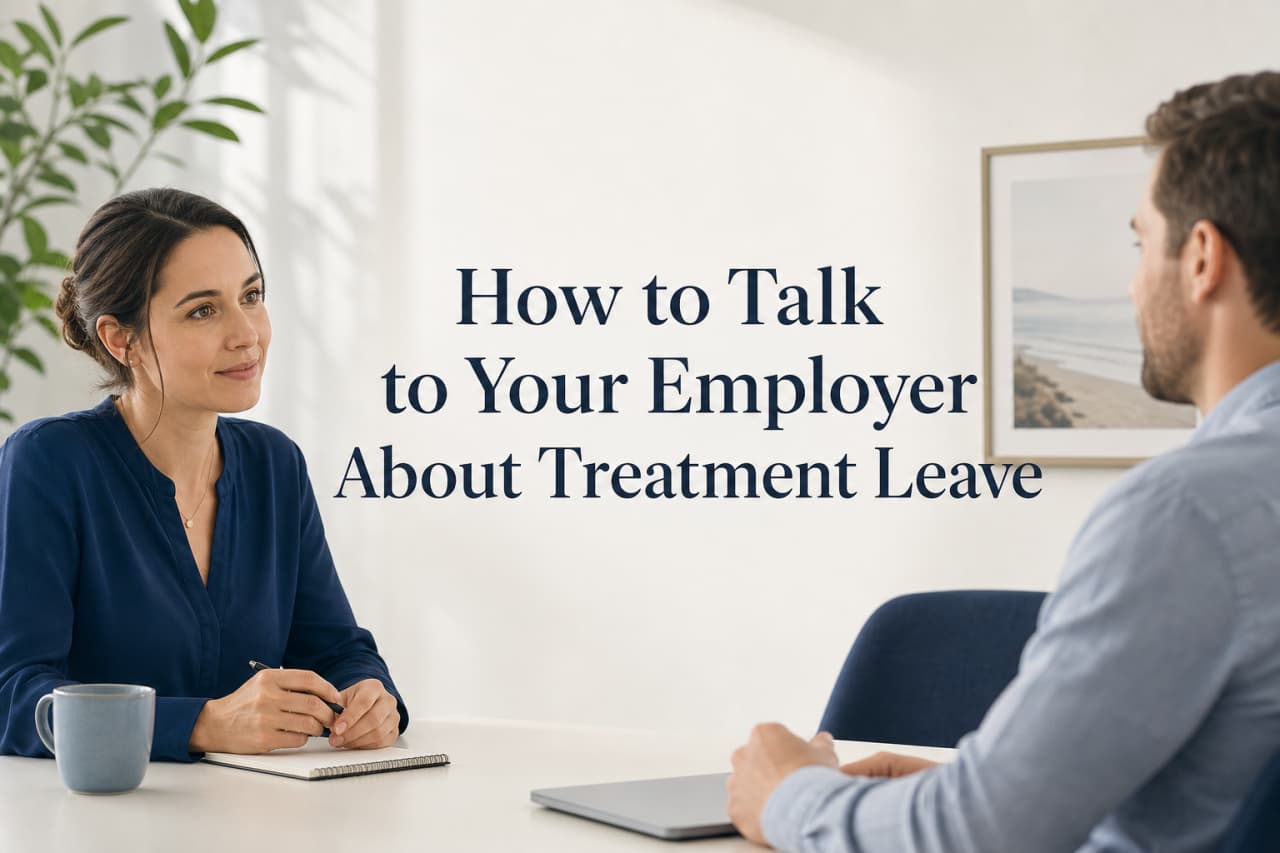
Most employers need four facts to start a leave request: the date leave may begin, the estimated duration, the work impact, and the type of leave or schedule change. If you're working out how to talk to your employer about treatment leave, lead with those facts. Your diagnosis, medications, and treatment history can stay out of the first conversation unless a lawful request makes them necessary.
Give HR the information needed to process leave, give your manager what they need to plan work, and send medical documents through the designated channel. Rize OC provides outpatient care in Lake Forest, Orange County.
Lead with your request, then pause. A workable framework covers your need, timing, work impact, and the next administrative step. Depending on the level of care you're assessed for, the request could be continuous leave, intermittent leave, or a temporary schedule change. Confirm the recommended treatment schedule before you present firm dates, and if it is still being assessed, tell HR which dates are estimates.
| Situation | Script framework | Privacy boundary |
|---|---|---|
| Initial conversation with a manager | I need medical leave beginning around [date]. I'm speaking with HR about the paperwork. I'll share the work-planning details once the dates are confirmed. | Leave out the diagnosis and treatment history. |
| Initial request to HR | I need information about requesting medical leave for a health condition. The anticipated start date is [date]. Please send me the required forms, deadlines, and submission instructions. | Ask HR what documentation is required before sending records. |
| Temporary schedule request | I'm requesting a temporary schedule change for medically necessary treatment. I expect to need [specific time block] beginning [date]. What accommodation process should I follow? | Describe the schedule need rather than the clinical details. |
| Manager asks for your diagnosis | I'd prefer to keep my diagnosis private. I'll provide the required medical certification through HR or the leave administrator. | Stay polite and repeat the administrative next step. |
| The start date is urgent | I need to begin medical leave on [date]. I'm giving notice as soon as I can. Please tell me how to submit the required certification. | Avoid promising a duration that your clinician hasn't confirmed. |
Order matters. State the request before any personal context, because a long explanation can expose private information without helping HR decide which form or process applies.
Share what the employer needs to evaluate leave or an accommodation. Your manager rarely needs your full clinical story. Keep the first conversation on functional facts such as when you expect to be unavailable, how treatment may affect your schedule, and which office should receive certification.
HIPAA doesn't generally protect employment records held by an employer, even when those records contain health information. The U.S. Department of Health and Human Services explains the difference between employment records and HIPAA-covered health records. Separate employment laws may still require an employer to keep medical information confidential, which is why forms should go only to the designated recipient.
| Usually relevant | Usually private unless specifically required |
|---|---|
| Estimated leave dates and expected duration | Details about trauma, family conflict, or events that led to treatment |
| The schedule restriction or work limitation | Medication names, doses, and side effects unrelated to the job request |
| A clinician's certification of the need for leave | Therapy notes or your complete medical record |
| A reliable way for HR to reach you about forms | Detailed history of substance use or prior treatment episodes |
If the conversation drifts, try this: "I can provide the medical certification required for leave, but I'd like to keep the underlying clinical details private."
Start with HR or the designated leave administrator when one exists. That person should explain forms, deadlines, benefits, and the employer's documentation process. Your manager needs enough to cover staffing and deadlines but usually shouldn't collect detailed clinical records.
If your workplace has no HR department, check the employee handbook for whoever handles medical leave, which might be an owner, an office administrator, or an outside leave company. A union representative may also explain procedures under a collective bargaining agreement. For planned outpatient care at Rize OC in Lake Forest, confirm the treatment schedule before discussing exact work coverage with your manager.
| Person | What to discuss | What to withhold |
|---|---|---|
| HR or leave administrator | Leave category, forms, deadlines, certification, benefits, and accommodation process | Clinical records beyond what the process requires |
| Direct manager | Dates, availability, active assignments, and a practical communication plan | Diagnosis, medications, therapy topics, and treatment history |
| Treatment provider | Clinical need, expected attendance, and forms the employer requests | Permission for broad employer access unless you understand and accept the release |
| Coworkers | Approved time away and necessary work handoffs | Medical information you don't want repeated |
You may know treatment is needed while the level of care and schedule are still being assessed. In that case, give HR an estimated start date and say that clinical confirmation is pending. You can call Rize OC at (949) 461-2620 to ask about admission timing and the attendance requirements for the outpatient care being considered.
| Check | Question to answer before the meeting |
|---|---|
| Treatment schedule | Is continuous leave, intermittent leave, or a recurring schedule change likely to be needed? |
| Employer process | Who receives the request, which forms apply, and what are the submission deadlines? |
| Medical certification | Which qualified clinician can complete the form, and how should HR send it? |
| Pay during leave | Will accrued paid time run with leave, and could a wage-replacement program apply? |
| Insurance | Has the health plan explained benefits, authorization rules, and possible personal costs? |
Leave approval, wage replacement, and health plan authorization are separate decisions. An approved leave request doesn't confirm that insurance will pay for treatment, and an approved treatment claim doesn't automatically create job-protected leave. Rize OC's admissions team verifies benefits for commercial plans, and it does not accept Medi-Cal or Medicaid. Coverage varies by plan and isn't guaranteed.
Federal and California rules may provide job-protected leave, workplace accommodation, or wage replacement, and each has its own eligibility test. The U.S. Department of Labor's mental health leave guidance explains how the Family and Medical Leave Act can cover qualifying mental health treatment. California employees should also review the Civil Rights Department's family and medical leave information.
| Option | What it may provide | Key limit |
|---|---|---|
| Federal FMLA | Up to 12 workweeks of unpaid, job-protected leave in a 12-month period for an eligible employee's serious health condition | A common eligibility test includes 12 months of employment, 1,250 hours worked, and 50 employees within 75 miles. Covered public employers follow different coverage rules. |
| California CFRA | Up to 12 workweeks of unpaid, job-protected leave for an eligible employee's own serious health condition | The law generally covers employers with five or more employees. Employee eligibility includes 12 months of service and 1,250 hours worked. |
| Federal ADA accommodation | A reasonable accommodation such as leave or a modified schedule for a qualified employee with a covered disability | The request can be denied if it would cause undue hardship or remove an essential job function. |
| California Disability Insurance | Partial wage replacement for eligible workers who can't perform their regular work because of a non-work-related illness or injury | Payment eligibility doesn't create job protection by itself. |
FMLA and CFRA may run at the same time, and an employer may apply paid time under its policy while protected leave is running. The Equal Employment Opportunity Commission explains that an accommodation request can use plain language, so you don't need to recite a statute in the first conversation. California's Employment Development Department provides separate Disability Insurance guidance.
If leave involves treatment for a substance use disorder, keep the request focused on medically necessary treatment. Employment rules can treat current illegal drug use differently from treatment for a substance use disorder or a person in recovery. Consider legal advice before giving details beyond the certification HR requests.
Company policy can't tell you the full legal answer. Employer size, your work history, the medical facts, and the requested schedule can change which protections apply. Ask HR for the written reason if a request is denied.
Confirm the conversation in writing on the same day. Your message should record the request, estimated dates, the forms you asked for, and the person assigned to respond. Keep copies in a secure personal location while following workplace rules about company records. Leave therapy notes, medication lists, and unrelated clinical history out of the email.
Sample follow-up email Subject: Medical leave request Thank you for speaking with me today. I'm requesting medical leave beginning around [date] for a health condition. The estimated duration or schedule restriction is [time period], subject to clinical confirmation. Please send me the required forms, submission instructions, and deadlines. I will provide certification through the designated HR or leave channel.
If Rize OC is the proposed treatment provider, ask which office should receive employer forms and which clinician is authorized to complete them. Don't assume every staff member can sign certification, and ask about processing time before telling HR when a completed form will arrive.
Save the original leave request and any confirmation of receipt, and write down the name and title of each person handling it. Track every form deadline, and ask for extensions in writing if a clinician needs more time. Review any medical release before signing, including what it covers and when it expires. Correct inaccurate dates or work restrictions as soon as you notice them.
Rize OC's intensive outpatient program runs about 3 to 9 clinical hours a week, with morning and evening tracks, and clients live at home. Its partial hospitalization program is daytime care and is the most structured outpatient level. A clinical assessment decides which level fits, and your employer decides workplace arrangements through its leave and accommodation process. Ask Rize OC what attendance the recommended option requires before requesting a specific schedule.
| Possible request | When it may fit | What to clarify with HR |
|---|---|---|
| Continuous leave | Treatment requires a full period away from work | Start date, estimated duration, certification, and use of paid time |
| Reduced schedule | You can work part of your regular schedule while attending recurring treatment | Temporary hours, workload expectations, pay impact, and review date |
| Intermittent leave | Medically necessary appointments occur in separate blocks of time | Notice procedure, timekeeping method, certification, and scheduling rules |
| Temporary workplace adjustment | A change in location, start time, or nonessential task could address a treatment-related limitation | Duration, essential job duties, privacy, and the accommodation review process |
Don't ask your manager to design the treatment schedule. Take the clinically recommended attendance requirements to HR and request the leave or accommodation that supports them. Choosing less care only to protect a preferred work schedule can leave the underlying clinical need unresolved.
Ask which part of the request caused the problem. A missing form calls for a different response than a finding that you're ineligible for a specific leave program. Request the reason and the next review step in writing, since a first verbal answer from a manager may not reflect HR's formal decision.
| Employer response | Your next move |
|---|---|
| We need more medical information | Ask which question remains unanswered and which form or certification standard applies. Send the response through HR. |
| You aren't eligible for this leave program | Ask for the eligibility calculation in writing and ask if another leave policy or accommodation process applies. |
| That schedule won't work | Ask to discuss other effective schedules through the accommodation process. Keep the clinical restrictions clear. |
| Tell your manager the diagnosis first | Ask if medical documents can go directly to HR or the leave administrator instead. |
| The request is denied | Request the written basis, appeal process, and any missing documentation. Consider guidance from the Department of Labor, EEOC, California Civil Rights Department, a union, or an employment attorney. |
Avoid resigning or abandoning treatment based on the first response. Deadlines can be short, so address missing paperwork promptly. Rize OC can discuss treatment planning at (949) 461-2620, but questions about workplace rights belong with your employer, a government agency, or legal counsel.
These answers cover the conversation that happens before leave begins. Rize OC is in Lake Forest and provides outpatient care for adults considering treatment while managing work responsibilities.
You often can request leave or an accommodation without giving your diagnosis directly to your boss. Your employer may request certification with enough medical facts to show that the leave or restriction qualifies. Ask HR what the form requires and who can view it. Keep detailed records out of ordinary manager emails unless the process specifically requires that recipient.
You generally don't need to name FMLA when first giving notice, but you must provide enough information for the employer to recognize that protected leave might apply. Saying you need time away for medically necessary treatment is clearer than saying you need personal time. HR can then ask follow-up questions and provide the correct forms.
Paid time may cover income while a protected leave designation addresses your job rights. Employer policy can require accrued paid time to run during FMLA or CFRA leave. Ask HR whether PTO runs at the same time as protected leave, how it affects your balance, and what happens after paid hours are exhausted.
Notify the employer as soon as practicable and follow its usual call-out procedure unless circumstances prevent that. Ask HR how to provide certification after leave begins and record the deadline. Tell the treatment provider about the form promptly. Approval isn't guaranteed, so keep copies of each notice and response.
Keep insurance verification separate from the leave request. HR or the health plan can explain plan terms, while the treatment provider can request benefit information for proposed care. Coverage, authorization, network status, and personal costs vary by plan. A benefits verification isn't a promise that the employer will approve leave or that the plan will pay every claim.
To discuss treatment planning before speaking with your employer, call (949) 461-2620. You can also request commercial insurance verification so you have clearer benefit information before setting leave dates. Coverage and authorization vary by plan.
Contact our team to discuss the treatment information you may need for leave planning.
About the Author
Helpful educational resources from Rize OC.
In This Article
Topics
Ready for Help?
Confidential support, same day.
A practical framework for protecting aftercare, managing work stressors, and responding early when warning signs appear.

Compare IOP dayparts by energy, work, childcare, sleep, travel, clinical fit, and insurance before you pick a schedule.
A week-by-week plan for timing employer forms, clinical admission, wage-replacement steps, and your return to work.




Take the Next Step
If you or a loved one is struggling with addiction or mental health, the Rize OC team is here to help — confidentially and with no obligation.