

Guides
September 11, 20269 min read
Virtual IOP Tech Setup and Privacy at Home
You'll know what device, internet connection, and room you need for virtual IOP, and how to keep sessions private in a shared home.
Rize OCRead
Same-day assessments · Orange County, CA
Rize OC
Editorial Team
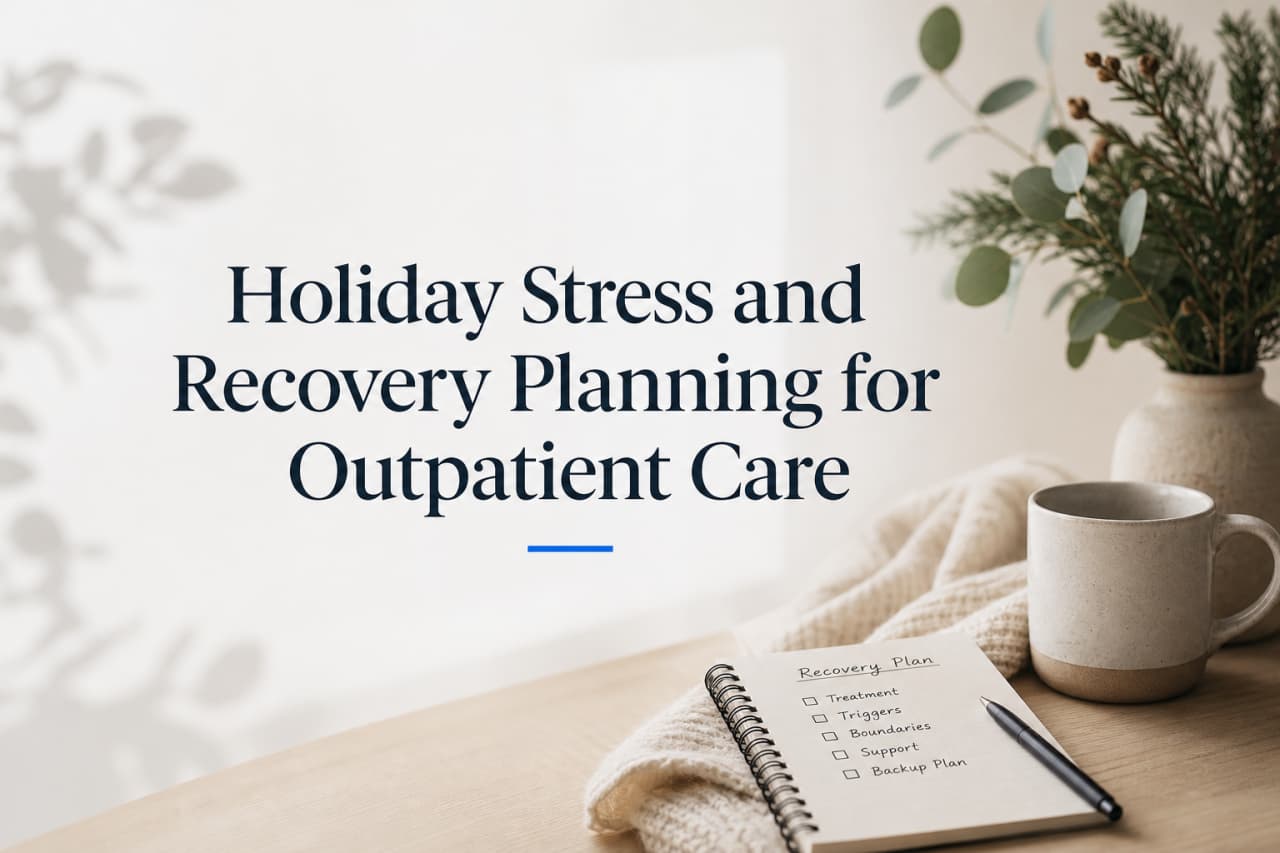
Holiday stress and recovery planning for outpatient care works best when it's written down by the end of October, because the invitation to a November party rarely mentions the open bar. IOP sessions, medication refills, and sleep routines that keep recovery steady often share a calendar with those gatherings. Use the steps below with your clinician, who decides your treatment schedule, medications, and any change in level of care.
If you're in suicidal or emotional crisis, call or text 988. For immediate danger, a suspected overdose, or a medical emergency, call 911.
October still leaves room to fix conflicts before invitations, work shifts, school breaks, and travel lock in. Put every IOP or OP session on the calendar first. Then add prescriber visits, therapy appointments, work hours, family events, and drive time. If you're in outpatient care at Rize OC in Lake Forest, count the drive between the clinic and any gathering elsewhere in Orange County.
Ask the Rize OC team about holiday scheduling before you book a trip or agree to host. Don't assume a regular meeting time will shift or stay put. Staff can tell you the actual schedule and help you work through conflicts.
| Planning point | Task |
|---|---|
| October | List treatment sessions, work shifts, travel, family events, and known closures. |
| Early November | Review conflicts with your care team and decide which invitations fit your plan. |
| Seven days before an event | Confirm transportation, arrival time, departure time, and support contacts. |
| The day before | Check your schedule, medications, meals, sleep plan, and exit route. |
| The next day | Attend scheduled care and review what changed during the event. |
Put treatment on the calendar first, then build holiday plans around it.
A useful plan covers three windows for each event, and it should match the risks your care team has already flagged. Bring a written draft to your next session, because memory fails under pressure at a crowded table.
Before the event, enter every IOP or OP session as a fixed appointment, and ask before you miss, shorten, or move care for travel or a family event. Choose events by risk. Who will be there, what substances may appear, how long it lasts, and how easily you can leave all matter. Set arrival and departure times in writing, since open-ended visits add pressure, and decide who controls the ride home. For example, an event that ends at 8:00 with your own car is a different risk than a sleepover at a relative's house.
During the event, watch for your early warning signs, such as stronger cravings, rising anxiety, poor sleep, skipped meals, or isolation. Choose two support contacts and write down what you want each one to do. One may handle the ride while the other stays reachable by phone. Check refill timing before offices close, and ask your prescriber or pharmacist about any medication question.
After the event, protect sleep, meals, and your next treatment contact so one hard evening doesn't wipe out several days. Update the checklist when a guest list grows or travel cuts into your schedule.
Start with situations that have affected you before, then link each one to a warning sign you can observe and a specific response. "Family conflict" alone gives almost no direction. A written plan might say that raised voices are your cue to step outside, text your support person, and leave if the conflict continues.
Logistics matter too. A gathering across Orange County can collide with treatment if you skip travel time from Lake Forest, and hosting at home can erase your usual exit route. Use the table as a prompt, then ask your clinician which risks belong in your plan.
| Situation | Possible early sign | Written response |
|---|---|---|
| An invitation has no end time | You feel trapped or begin looking for a reason to cancel care | Set a departure time before accepting and control your ride home. |
| Alcohol or drugs are present | You start bargaining with yourself about staying | Move away from the area, contact support, or leave according to your plan. |
| Family conflict starts | Your voice rises or you rehearse an argument | Use a prepared boundary and step outside before deciding whether to return. |
| Grief or loneliness increases | You withdraw and stop answering messages | Keep a planned check-in and tell your care team if symptoms intensify. |
| Travel affects treatment | You consider skipping without speaking to the program | Contact the program before changing attendance or booking the trip. |
| Sleep and meals change | Irritability, fatigue, or cravings rise | Return to the routine documented with your care team. |
A trigger plan works when it connects a warning sign to an action you can take.
Treat scheduled care as the fixed part of your week. An unplanned absence removes a known point of contact right when routines already shift. Rize OC's IOP, for example, often meets on multi-day weeks, commonly Monday, Wednesday, and Friday, in groups of eight or fewer, so a missed session is noticeable. Ask your clinician what to do if work, travel, illness, or a program closure affects attendance.
Confirm the Lake Forest schedule with staff, not with a relative who assumes treatment pauses for a holiday. If you plan to leave Orange County, share your dates, destination, transportation, and expected return before you go.
| Schedule problem | Planning response |
|---|---|
| A gathering overlaps with treatment | Keep the clinical appointment unless your care team approves another plan. |
| Work adds a holiday shift | Discuss the conflict as soon as the shift is posted. |
| You want to travel | Review dates, attendance expectations, medications, and local support before booking. |
| Transportation falls through | Identify a backup ride or ask the program which attendance options apply to you. |
| Symptoms become harder to manage | Contact your clinician instead of waiting for the next routine session. |
If you're getting care for both mental health and substance use, plan for both. Poor sleep hits mood, and conflict or alcohol exposure can raise urges. Ask the team how your dual-diagnosis needs change your holiday response plan.
Decide your response before you arrive. Confirm what may be present, choose your transportation, and set a departure time. Driving yourself gives you control when driving is safe and fits your plan, while a sober friend or rideshare may suit another situation. Your care team can help you choose.
Keep refusal language short. You can say, "No, thanks. I have an early morning," or "I'm leaving at 8:00." You don't owe anyone details about treatment, and if someone pushes, repeat the same sentence and move toward your exit.
Give support people defined tasks. One can check in before the event and another can drive. Tell them which signs mean you want help and which decisions stay yours. Vague monitoring creates conflict when you need practical help.
A return to substance use is a reason to tell your clinician promptly, because it can mean your treatment needs to be adjusted. The NIDA overview of treatment and recovery describes it that way. If you might be exposed to opioids, ask your prescriber or pharmacist what precautions make sense for you.
| Need | Plain-language script |
|---|---|
| Decline a drink or drug | "No, thanks. I'm good with this." |
| End a treatment discussion | "I'm keeping that private, but I appreciate your concern." |
| Set a departure time | "I'm heading out at 8:00." |
| Ask for help | "I need my ride now. Please stay with me until it arrives." |
| Leave a conflict | "I'm stepping outside. I'll decide from there if I'm coming back." |
Contact your clinician when symptoms, cravings, substance use, or safety concerns move past the responses written in your plan. Rize OC's placement process uses an ASAM criteria-based assessment of your needs and risk, so a change in either can change the level of care that fits. Your holiday plan should say which changes call for routine discussion, prompt contact, or emergency help.
Rize OC can discuss treatment-plan concerns at (949) 461-2620.
| Level | Examples | Action |
|---|---|---|
| Routine | Mild stress, a manageable craving, or a schedule question | Use the written plan and discuss the event at your next scheduled contact. |
| Rising concern | Worsening symptoms, repeated urges to abandon the plan, or trouble using coping steps | Leave the situation if needed and contact your clinician or named support person promptly. |
| Clinical change | A return to use, missed care, medication concerns, or symptoms that interfere with daily functioning | Tell your treatment team as soon as possible so they can assess the next step. |
| Emergency | Suicidal intent, immediate danger, suspected overdose, or severe medical symptoms | Use emergency services and seek emergency care. |
Write emergency contacts into your plan before the event. A crisis is a bad time to search for a phone number.
Review the facts before judging the whole night. Record when you arrived, when you left, which triggers appeared, what you did, and what happened next. Note any changes in sleep, mood, cravings, medication routines, or substance use, and bring that short review to your next session, ideally within a day or two.
Keep the parts that worked and revise the rest. An early departure may show the exit plan did its job, while a missed support call may mean the contact or the time needs to change. One difficult event doesn't oblige you to accept every invitation that follows.
Tell your clinician about a return to use or a sharp change in symptoms. Hiding it delays assessment. Your care team can review what happened and decide whether the treatment plan, visit schedule, safety plan, or level of care needs attention.
If you travel and can't reach your usual resources, SAMHSA's treatment locator lists treatment providers by location, so you don't have to wait until you're back in Lake Forest.
Your own treatment plan takes priority over these general answers, because attendance expectations, symptoms, medications, and support needs differ.
Make a risk decision for each event. Weigh treatment conflicts, substance exposure, family behavior, transportation, sleep, and your current symptoms. A short daytime visit with your own ride may fit your plan, and an open-ended gathering with active substance use may not. Review uncertain invitations with your clinician.
Ask your care team before changing attendance. Travel plans don't automatically change program expectations. Give Rize OC your proposed dates early enough to discuss treatment contacts, medication questions, local resources, and your return schedule, and book after you know the clinical plan.
Use one refusal sentence and your exit plan. Repeated pressure raises the risk of staying, so move toward your transportation and contact the support person named in your plan. Your family doesn't have to agree with your boundary for you to leave.
Tell your treatment team promptly and report what you used, when, and any symptoms you have. Accurate information helps the clinician assess safety and care needs. A suspected overdose or severe medical symptoms call for emergency services right away.
Coverage varies by plan, service, network rules, and medical-necessity decisions. Rize OC verifies commercial-plan benefits, but verification isn't a guarantee of payment, and Rize OC doesn't accept Medi-Cal. If you use Medi-Cal, you can reach your county through the California DHCS substance use disorder access line directory for public pathways.
Bring your October planning checklist to your next appointment, or call Rize OC at (949) 461-2620 to talk through outpatient care in Lake Forest. You can ask about IOP, OP, dual-diagnosis planning, admissions, or insurance verification.
Make the call before November plans harden into fixed dates.
About the Author
Helpful educational resources from Rize OC.
In This Article
Topics
Ready for Help?
Confidential support, same day.
You'll know what device, internet connection, and room you need for virtual IOP, and how to keep sessions private in a shared home.

Five PHP fit profiles, what the day demands after you leave, signs another level may fit better, and questions worth asking before admission.

A 90-day plan for the weeks after PHP or IOP, with what to schedule first, what to test later, and when to step care back up.



Take the Next Step
If you or a loved one is struggling with addiction or mental health, the Rize OC team is here to help — confidentially and with no obligation.