

Guides
September 23, 20268 min read
Lake Forest Treatment Center Logistics: Parking, Hours, and Visitors
Confirm parking, appointment hours, suite access, and visitor plans with Rize OC before traveling to Lake Forest.
Rize OCRead
Same-day assessments · Orange County, CA
Rize OC
Editorial Team
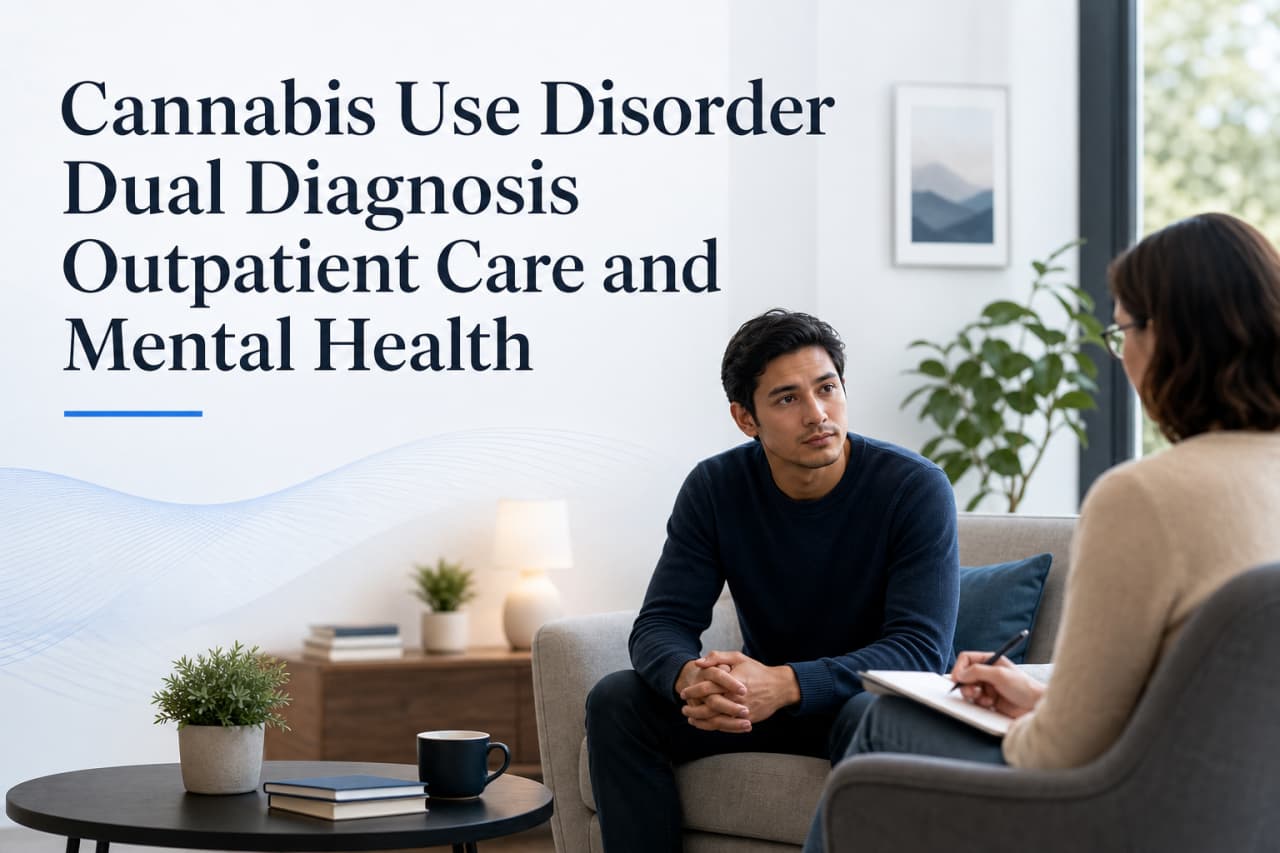
Hallucinations, suicidal thoughts, or an inability to stay safe require emergency care first. For medically stable adults, cannabis use disorder dual diagnosis outpatient care treats cannabis use together with anxiety, depression, or psychosis-related symptoms. The plan tracks both problems at once and sets the level of care from your current risk.
Detox drinks and THC-clearing timelines answer a testing question. They do not explain why use continues, how mood shifts after use, or whether paranoia marks a psychiatric emergency. Dual diagnosis care focuses on symptoms, safety, daily function, and the patterns that keep cannabis use going. This page is educational and does not replace an assessment by a licensed clinician.
Cannabis intoxication can trigger anxiety, panic, paranoia, and changes in perception. Repeated use can also sit beside an independent anxiety disorder, depressive disorder, or psychotic disorder. The National Institute on Drug Abuse reports an association between cannabis use and psychosis risk, with heavier exposure tied to greater concern. An association does not prove cannabis caused every psychiatric condition. It still calls for careful assessment.
Timing gives the clearest starting point. A clinician will ask what you felt before using, what changed during intoxication, and what happened as the effects faded. Symptoms that hold during sustained nonuse may point to an independent mental health condition. Symptoms that show up reliably after cannabis exposure suggest a substance-related effect. Both patterns can show up in the same person.
Cannabis use disorder rests on impairment and loss of control, not a single dose or frequency. Warning signs include repeated failed efforts to cut back, continued use after mental health problems appear, craving, withdrawal symptoms, and missed responsibilities. Tolerance can matter. A person may move to stronger products over time while getting less relief from the anxiety or insomnia that first led to use.
When you speak with Rize OC in Lake Forest, bring a simple timeline. Note when cannabis use rose, when anxiety or depression shifted, and any episodes of severe paranoia or altered perception. Include stretches when you were not using. Those stretches help clinicians compare baseline symptoms with intoxication and withdrawal effects.
It targets the clinical reasons cannabis use continues and the mental health symptoms that drive or follow it. A plan may include substance use counseling, psychiatric assessment, symptom monitoring, and safety planning. The mix depends on diagnosis, current stability, other substances, medications, and living situation.
A positive urine test shows cannabis metabolites are present. It cannot measure judgment, mood stability, motivation, or psychosis risk. Detection time also varies with exposure and individual factors. Clinicians judge progress through changes in use, symptoms, relationships, work, sleep, and follow-through with care. A lab result is one data point.
| Question | Flush-focused information | Dual diagnosis outpatient care |
|---|---|---|
| What is the main target? | Changing or predicting a drug test result | Reducing cannabis-related impairment while treating mental health symptoms |
| What gets assessed? | Recent use and possible detection time | Use pattern, withdrawal, mood, psychosis risk, medications, safety, and daily function |
| How is progress judged? | A negative test | Symptoms, use patterns, stability, relationships, work, and treatment participation |
| What happens if risk rises? | The question may go unaddressed | The clinician reassesses safety and considers a higher level of care |
The Substance Abuse and Mental Health Services Administration recommends integrated care for co-occurring mental health and substance use disorders. Separate plans can produce conflicting advice. One clinician may push abstinence while another treats anxiety without knowing how cannabis affects it. Coordinated care gives both problems a shared timeline and shared goals.
No medication is approved specifically for cannabis use disorder. Behavioral care remains the main treatment path, though a prescriber may recommend medication for a diagnosed mental health condition or a specific symptom. Rize OC's outpatient continuum in Orange County can explain how dual diagnosis care differs from a detox-only referral and what assessment should come next.
Outpatient care may fit when you are medically stable, can take part between appointments, and pose no immediate danger to yourself or anyone else. Your home setting should also allow treatment participation and basic safety. A clinical assessment makes this call. Cannabis use frequency alone cannot set the right setting.
| Current situation | Level-of-care question |
|---|---|
| Stable health, manageable symptoms, and reliable participation | Standard outpatient or an intensive outpatient program may be considered |
| Symptoms disrupt work, sleep, or daily responsibilities despite lower-intensity care | A more structured outpatient schedule or partial hospitalization may be considered |
| Unsafe living conditions or repeated inability to follow an outpatient safety plan | Residential or another supervised setting may need evaluation |
| Active psychosis, suicidal intent, violent behavior, or a severe medical problem | Emergency or hospital-based assessment is appropriate |
The American Society of Addiction Medicine describes level-of-care placement as a multidimensional decision. Clinicians weigh intoxication and withdrawal, physical health, psychiatric symptoms, return-to-use risk, motivation, and the recovery setting. That approach blocks a common error: placing someone by the drug name while ignoring current safety and functioning.
Cannabis withdrawal can bring irritability, sleep disruption, anxiety, low appetite, and strong urges to use. Other substances change the risk math. Alcohol, sedatives, stimulants, opioids, and prescribed medications should all be named during assessment. A history of mania, psychosis, seizures, or suicide attempts also shapes the setting a clinician may recommend.
Call 911 or go to the nearest emergency department if you may harm yourself or another person, cannot meet basic needs, or are experiencing severe confusion, hallucinations, or escalating paranoia. You can also call or text 988 for the Suicide & Crisis Lifeline. Rize OC's outpatient line is not a substitute for emergency care.
For a nonemergency assessment discussion, Rize OC can be reached at (949) 461-2620. The Lake Forest team can review outpatient options and help decide whether a clinical evaluation or a different level of care makes sense. No outpatient program can guarantee results, and placement may change if symptoms become less stable.
Assessment starts with a timeline, current symptoms, and immediate safety. The clinician needs direct answers on cannabis frequency, product type, estimated potency when known, and the time of your last use. You should also report alcohol or other drug use, prescriptions, sleep changes, medical concerns, and prior treatment.
| Assessment area | What the clinician needs to determine |
|---|---|
| Immediate safety | Presence of suicidal thoughts, violent behavior, severe confusion, hallucinations, or inability to meet basic needs |
| Cannabis pattern | Frequency, product type, potency when known, triggers, attempts to stop, and withdrawal symptoms |
| Mental health | Onset and course of anxiety, depression, mania, paranoia, altered perception, or cognitive changes |
| Physical health | Medical conditions, pregnancy status when relevant, medication effects, and recent changes in appetite or sleep |
| Daily setting | Housing stability, access to cannabis, transportation, work demands, and reliable support |
| Treatment history | What you tried, what helped, what caused problems, and why previous care ended |
Bring your medication list and cannabis packaging if you still have it. Product labels can help estimate THC concentration, though labels are not a stand-in for laboratory confirmation. Write down recent episodes of panic, severe depression, paranoia, or disorganized thinking. Include the date, what you used, how much you recall using, and how long the symptoms seemed to last.
A single intake may not settle the diagnosis. Intoxication, withdrawal, poor sleep, and acute stress can warp the first clinical picture. The working diagnosis may shift as the team watches symptoms across periods of use and nonuse. That shift reflects new evidence. It does not mean your original report was dismissed.
Psychosis deserves prompt evaluation even when it occurred only during intoxication. The National Institute of Mental Health describes warning signs that can include hallucinations, delusions, confused speech, social withdrawal, and trouble telling reality from fantasy. Family observations may help if you consent to their involvement, especially when memory of the episode is incomplete.
Rize OC's outpatient continuum in Lake Forest can walk through the assessment process and the available intensity of care. Ask who completes the psychiatric evaluation, how substance use and mental health clinicians share information, and what happens if safety needs change after admission. Clear escalation rules matter before symptoms worsen.
Treatment should run on one coordinated plan for cannabis use and mental health symptoms. Therapy should name what cannabis does for you in the short term, what costs show up later, and which situations predict use. The psychiatric side should track mood, anxiety, sleep, perception, medication effects, and safety.
NIDA identifies cognitive behavioral therapy, motivational enhancement therapy, and contingency management among the behavioral approaches studied for cannabis use disorder. Cognitive behavioral work examines triggers and practiced responses. Motivational work addresses ambivalence without arguing. Contingency management ties defined incentives to measurable treatment behaviors. Availability depends on the program.
A psychiatric evaluation can address an independent anxiety, depressive, bipolar, trauma-related, or psychotic disorder. Medication may be considered for a diagnosed condition, but prescribing requires an individual assessment. Cannabis can affect attention, sleep, anxiety, and adherence, so your prescriber needs an accurate account of current use. Never stop a prescribed psychiatric medication based on online information.
| Treatment target | Clinical mechanism | Useful progress signal |
|---|---|---|
| Cannabis use | Identify triggers, practice alternative responses, and plan for high-risk situations | Changes in use days, craving, consequences, and return-to-use patterns |
| Anxiety or depression | Track symptoms, build coping skills, and address avoidance or withdrawal from daily activities | Changes in symptom severity, sleep, work, relationships, and self-care |
| Psychosis risk | Monitor warning signs, reduce exposure linked with episodes, and maintain an escalation plan | Earlier reporting of warning signs and follow-through with urgent evaluation |
| Medication care | Review benefits, side effects, adherence, and interactions with ongoing substance use | Consistent use as prescribed and prompt reporting of adverse effects |
| Recovery setting | Address access to cannabis, conflict at home, transportation, and exposure to use | Reliable attendance and fewer disruptions that interfere with treatment |
Treatment planning should also cover recurrence prevention. A return to cannabis use supplies information about the trigger, the available response, and any gap in the plan. Clinicians can then adjust visit frequency, therapy targets, psychiatric care, or the level of structure. Shame adds nothing useful to that analysis.
Ask Rize OC how its Orange County outpatient continuum coordinates dual diagnosis services, intensive outpatient care, and mental health treatment. Ask how progress is reviewed and who makes level-of-care decisions. You should leave knowing what will be measured, how often the plan is reviewed, and which events trigger a higher level of care.
A written daily record beats memory alone. Log cannabis use, symptoms before and after use, sleep, prescribed medications, and basic functioning. Include days without cannabis. The aim is to spot repeated sequences, not to prove a diagnosis from one hard night.
| What to record | Pattern worth discussing with a clinician |
|---|---|
| Time, product type, and estimated potency | Panic, paranoia, low mood, or altered perception repeatedly follows certain products or exposure levels |
| Reason for using | Cannabis gives short-term relief, followed by stronger anxiety, low mood, poor sleep, or renewed craving |
| Symptoms on nonuse days | Mental health symptoms continue outside intoxication and withdrawal periods |
| Sleep and appetite | Changes appear during heavier use, attempted reduction, or a return to use |
| Work, relationships, and self-care | Use continues despite missed duties, conflict, isolation, or reduced ability to care for yourself |
| Safety signs | Suicidal thoughts, hallucinations, severe confusion, aggression, or inability to recognize danger |
Withdrawal can muddy the record. Anxiety, irritability, sleep problems, and appetite changes may appear after cutting cannabis, even if cannabis was also worsening those symptoms during use. A clinician can compare timing and severity over a longer stretch. Self-diagnosis from a few days of symptoms can miss that distinction.
Watch function closely. Cannabis may feel calming while attendance, relationships, hygiene, finances, or medication routines steadily fall off. The immediate feeling and the longer pattern can point different ways. Treatment decisions should account for both.
Severe paranoia or altered perception should speed up action. Waiting for a THC test to turn negative can delay psychiatric evaluation. If you remain safe and medically stable, Rize OC in Lake Forest can discuss a dual diagnosis outpatient assessment. Call (949) 461-2620 for a nonemergency conversation about the next clinical step.
Cannabis withdrawal can be distressing and may worsen sleep, anxiety, irritability, appetite, or depressed mood. A clinician still needs to review your medical history, psychiatric symptoms, medications, and use of other substances. Alcohol, sedatives, opioids, or stimulants can create separate withdrawal and safety risks. Seek urgent care if withdrawal comes with suicidal thoughts, severe confusion, hallucinations, chest pain, seizures, or an inability to stay safe.
Outpatient care can assess the original symptom and the effects of continued cannabis use when your current safety and stability fit that setting. Treatment may examine sleep routines, anxiety triggers, withdrawal effects, prescribed medications, and the reasons cannabis became your main coping method. The aim is a plan you can follow without ignoring the condition that led you to use.
Psychosis during intoxication still warrants prompt clinical evaluation. The episode may be substance-induced, may reveal an independent disorder, or may stay unclear until clinicians watch symptoms over time. Report hallucinations, fixed false beliefs, disorganized behavior, severe paranoia, and any loss of contact with reality. If those symptoms are active or returning quickly, use emergency services rather than waiting for an outpatient appointment.
You do not need a negative test or a self-assigned diagnosis to request an assessment. Tell the clinician when you last used and if you feel intoxicated. Do not drive while impaired. Arrange safe transportation if needed. The clinical team can assess your immediate condition, discuss withdrawal concerns, and determine the right setting without relying on a home detox or flush method.
Coverage varies by plan, medical-necessity criteria, benefits, network rules, and authorization requirements. Rize OC does not accept Medi-Cal. People with Medi-Cal can review public behavioral health pathways through the California Department of Health Care Services or their county plan. Rize OC offers commercial-plan verification at no cost where applicable, but verification is not a guarantee that an insurer will pay every claim.
Call Rize OC at (949) 461-2620 to discuss dual diagnosis outpatient care in Lake Forest. You can also use the Contact Us page or commercial insurance verification form on rizeoc.com. If safety is at risk, call 911, contact 988, or go to the nearest emergency department.
About the Author
Helpful educational resources from Rize OC.
In This Article
Topics
Ready for Help?
Confidential support, same day.
Confirm parking, appointment hours, suite access, and visitor plans with Rize OC before traveling to Lake Forest.

Build a 90-day post-PHP or IOP plan with scheduled care, weekly structure, warning signs, crisis steps, and Orange County logistics.

Weekly ERP can leave long gaps when OCD and substance use interact. Compare IOP with weekly treatment and higher levels of care.



Take the Next Step
If you or a loved one is struggling with addiction or mental health, the Rize OC team is here to help — confidentially and with no obligation.