

Guides
September 11, 202611 min read
Virtual IOP Tech Setup and Privacy at Home
Prepare a private home space for virtual IOP with device checks, room privacy steps, secure settings, and backup plans.
Rize OCRead
Same-day assessments · Orange County, CA
Rize OC
Editorial Team
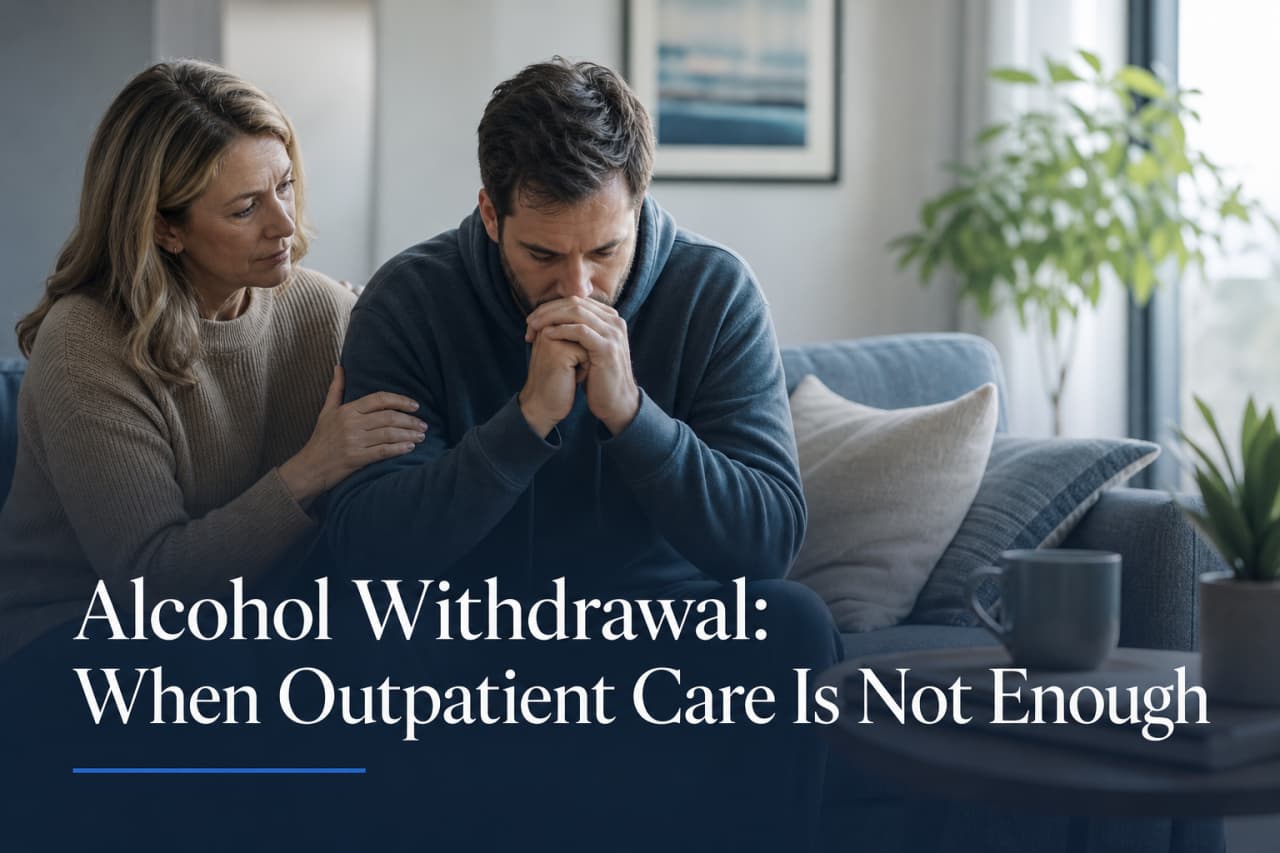
Call 911 if someone has a seizure, cannot stay awake, faints, or shows confusion or hallucinations that put them in danger. Those signs need emergency evaluation before any program admissions call. Outpatient care fails as a plan when symptoms can’t be monitored safely between visits, health risks are unstable, or the home setting can’t support a rapid move to medical care.
This page provides general education. It can’t replace an examination or medical advice from a licensed clinician. If you suspect an immediate medical emergency, call 911 before calling an admissions team.
Call 911 for a seizure, severe disorientation, hallucinations, loss of consciousness, trouble breathing, chest pain, or behavior that creates an immediate danger. Persistent vomiting, strong agitation, unstable vital signs, and heavy sedation can also require transfer from ambulatory care, according to the ASAM Clinical Practice Guideline on Alcohol Withdrawal Management. Families usually can’t assess blood pressure, pulse, or medication effects accurately at home. Visible changes in awareness and behavior matter. An emergency call should come before a call to Rize OC.
| What you see | What to do | Why outpatient care falls short |
|---|---|---|
| A seizure or repeated seizure activity | Call 911 immediately | The person needs rapid medical assessment and monitoring for another seizure. |
| Severe confusion, inability to recognize family, or trouble staying awake | Call 911 immediately | These signs can reflect severe withdrawal, medication effects, or another medical emergency. |
| Hallucinations, high agitation, or unsafe behavior | Call 911 and keep a safe distance if needed | Scheduled outpatient visits can’t provide continuous observation or immediate intervention. |
| Chest pain, fainting, trouble breathing, or blue or gray skin | Call 911 immediately | These symptoms require emergency assessment regardless of their cause. |
| Repeated vomiting with weakness, confusion, or inability to keep fluids down | Seek emergency evaluation; call 911 if the person is faint, confused, or hard to wake | Dehydration and other medical problems can progress between outpatient appointments. |
One red flag is enough to call 911.
Call 911, note when the seizure began, and move nearby objects that could cause injury. Don’t hold the person down or put anything in their mouth. If you can do so safely, turn them onto their side after the shaking stops and follow the dispatcher’s instructions. Don’t offer food, water, or medication until emergency personnel say it’s safe. A person who appears alert after a seizure still needs medical evaluation because another seizure or a different complication may follow.
Call 911 when there is an immediate threat, access to a weapon, severe confusion, or a medical withdrawal emergency. Give the dispatcher the person’s alcohol history, last known drink, current symptoms, and any medications or other substances involved. The 988 Suicide & Crisis Lifeline can help during an emotional crisis without an immediate medical threat, as explained by the National Institute of Mental Health. Alcohol withdrawal symptoms still require medical screening.
A higher level of care is usually safer when the person has current severe symptoms, a history of complicated withdrawal, unstable health conditions, or no reliable monitoring at home. The placement decision should come from a clinician who can assess the full situation. Rize OC provides an outpatient continuum in Lake Forest, but outpatient placement depends on medical stability. Convenience, work demands, or a preference to sleep at home can’t remove a known withdrawal risk. Families comparing options for alcohol withdrawal when outpatient not enough should treat history and home monitoring as hard placement factors.
A prior withdrawal seizure or withdrawal delirium weighs heavily in the placement decision. Repeated withdrawal episodes, long periods of regular heavy drinking, and dependence on sedating medications can also raise concern. Tell the clinician about every past withdrawal episode, including events that occurred years ago. Families sometimes leave out a seizure because it was brief or never formally diagnosed. That information can change the recommended setting even when current symptoms appear mild.
A past seizure changes today’s placement decision.
| Decision factor | Outpatient care may remain possible | A higher level may be needed |
|---|---|---|
| Current symptoms | Symptoms are mild, stable, and responsive to the prescribed plan | Symptoms are worsening, severe, or include confusion, hallucinations, seizure, or persistent vomiting |
| Withdrawal history | No history of seizure or withdrawal delirium | Past seizure, withdrawal delirium, or several difficult withdrawal episodes |
| Physical health | Health conditions are stable and a clinician has reviewed them | Unstable illness, injury needing closer observation, pregnancy, or a condition requiring closer medical observation |
| Mental health | The person can communicate, follow instructions, and report changes | Suicidal intent, psychosis, severe agitation, impaired judgment, or inability to follow the plan |
| Home logistics | A reliable adult can stay nearby, transportation works, and emergency care is accessible | The person is alone, the setting is unsafe, or rapid transportation isn’t available |
| Follow-up | The person can attend every scheduled assessment | Missed visits, refusal of monitoring, or no practical way to return for reassessment |
Outpatient withdrawal care depends on what happens between appointments. A reliable adult must be able to notice confusion, heavy sleepiness, vomiting, or a seizure and act without delay. The household also needs working transportation, a charged phone, and a clear route to emergency care. Living alone doesn’t automatically require inpatient care, but it can remove the monitoring that makes an ambulatory plan workable. Distance from an emergency department matters when symptoms can change within hours.
Safe ambulatory care requires scheduled clinical monitoring, a written medication plan when medication is prescribed, reliable support at home, and clear transfer instructions. The ASAM guideline recommends daily check-ins with a qualified health professional for up to five days after alcohol use stops or drops sharply. The exact schedule depends on the assessment. A family member watching from another room without clinical follow-up doesn’t meet that standard.
| Part of the plan | What it should answer |
|---|---|
| Clinical check-ins | Who will assess symptoms, how often contact occurs, and what happens after a missed visit |
| Medication instructions | What to take, when to take it, which warning signs require a call, and which substances or medications to avoid |
| Home observation | Who will remain available and how that person will recognize worsening confusion, sedation, vomiting, or agitation |
| Transportation | Who can drive to scheduled care and how emergency transportation will be requested |
| Escalation plan | Which symptoms require the prescriber, an emergency department, or 911 |
A missed daily check-in can remove the safety net.
Withdrawal may begin within 6 to 24 hours after a major reduction in alcohol use. ASAM reports that seizures can begin about 8 to 48 hours after stopping or reducing alcohol, while withdrawal delirium often begins later. These timeframes explain why an early calm period can’t clear someone for unsupervised care. The timing also varies with drinking patterns, medications, other substances, and health conditions. The clock never replaces a clinical assessment.
Use withdrawal medication only under a prescriber’s instructions. Don’t add leftover sedatives, sleep aids, opioid medication, or another person’s prescription. Report unexpected sleepiness, unsteady walking, slowed breathing, confusion, or difficulty waking the person. Call 911 for breathing trouble or inability to wake. A family should also avoid creating its own alcohol taper. If the person is currently stable and planning to stop, contact a clinician for an assessment before attempting withdrawal at home.
The decision uses current symptoms, expected withdrawal severity, physical health, mental health, past treatment history, and the living situation. ASAM’s framework asks clinicians to look beyond a single symptom score because two people with the same visible tremor can have very different seizure histories and home risks. Rize OC can gather background information during an admissions conversation in Lake Forest, but emergency clinicians and withdrawal-management providers must determine if medical detox or hospital care comes first.
| Assessment area | Details the clinician may review | How it affects placement |
|---|---|---|
| Current withdrawal | Last drink time, whether symptoms are increasing, and whether the person is oriented and able to walk safely | Worsening symptoms or impaired awareness can require continuous monitoring. |
| Medical health | Heart, liver, seizure, pregnancy, injury, or medication concerns | Active or unstable conditions may require hospital resources. |
| Mental health | Suicidal intent, psychosis, panic, severe depression, or impaired judgment | Immediate safety risks can rule out home-based monitoring. |
| Alcohol and medication history | How much and how often the person has been drinking, plus sedative or other substance use | Long-term patterns and medication interactions can change risk. |
| Living situation | Who can stay with the person, whether transportation is reliable, and how quickly emergency care can be reached | Weak home monitoring can make outpatient care unsafe even with mild initial symptoms. |
| Participation | Whether the person can follow instructions, attend daily contact, and report symptoms honestly | Inability or refusal to participate can require a setting with closer observation. |
A symptom scale records what is happening at one point in time. It may miss future seizure risk, an unsafe home, or a medical condition that changes the plan. Anxiety, infection, head injury, and some medications can also affect symptoms used in withdrawal scoring. Families shouldn’t use an online score to approve home detox. A trained clinician must interpret the result alongside medical history, observation, vital signs, and the person’s ability to follow the plan.
A score never gets the final vote.
Accurate information helps the receiving team decide how urgently the person needs care. Estimates are acceptable when exact details aren’t known. Don’t delay an emergency call while gathering records.
The next step addresses alcohol use disorder after acute medical risk has stabilized. Withdrawal management can reduce immediate danger, but it doesn’t resolve the patterns that led to continued alcohol use. ASAM recommends connecting withdrawal care with ongoing treatment rather than treating detox as a stand-alone event. Rize OC’s outpatient continuum in Lake Forest can be considered after a medical team confirms that the person can participate safely outside an inpatient setting.
Medical stability comes before therapy scheduling.
Outpatient treatment can address alcohol use, recurrence risk, mental health needs, family concerns, and plans for returning to work or daily responsibilities. The right intensity depends on the post-withdrawal assessment. Some people need frequent structured care, while others can attend fewer appointments. Discharge paperwork from a hospital or detox provider helps the next team review medications, follow-up needs, and unresolved medical concerns. Keep that paperwork available during the Rize OC admissions conversation.
Coverage, deductibles, authorization rules, and network status vary by plan. Rize OC can verify commercial insurance benefits at no charge, but verification doesn’t guarantee payment or admission. Rize OC doesn’t accept Medi-Cal. Families using Medi-Cal can contact the county access line listed by the California Department of Health Care Services or search the SAMHSA treatment locator for other care options. Emergency treatment should never wait for benefit verification.
These answers address common questions families ask Rize OC while deciding if outpatient care is safe. They don’t replace an examination, and any seizure, severe confusion, hallucination, breathing problem, or loss of consciousness requires emergency action.
Yes, mild symptoms can progress as withdrawal develops. A person may initially have anxiety, sweating, nausea, or a tremor and later develop a seizure, hallucinations, or confusion. Early symptoms can’t predict the entire course without the person’s history and clinical findings. Follow the monitoring schedule provided by the clinician. Call 911 if an emergency sign appears rather than waiting for the next appointment.
A past uncomplicated withdrawal doesn’t guarantee that the next episode will remain mild. Risk can change with age, health conditions, medications, recent alcohol use, and the number of prior withdrawal episodes. A history of stopping without medical care still belongs in the assessment. The safest decision comes from a clinician who reviews current symptoms and past events before the person attempts withdrawal at home.
An intensive outpatient program is generally considered after acute withdrawal risk is medically stable. Scheduled therapy sessions don’t provide continuous medical observation for seizures, delirium, unstable vital signs, or heavy sedation. A clinician may recommend withdrawal management before outpatient treatment begins. Rize OC can discuss the outpatient continuum and help clarify which assessment should happen first, but emergency symptoms require 911.
The monitoring period should follow a clinician’s plan because risk varies by person. ASAM recommends daily contact with a qualified health professional for up to five days in ambulatory withdrawal management. Some people need longer follow-up for medical or psychiatric concerns. Family observation can support that plan, but it can’t replace clinical contact. New confusion, hallucinations, seizure activity, fainting, or trouble waking the person requires immediate action.
Call 911 if the person has an emergency sign or poses an immediate danger, even if they object to care. Describe the symptoms and let trained responders assess the situation. Avoid physically restraining someone who is confused or aggressive unless a dispatcher gives specific directions. If no emergency sign is present, an admissions or clinical team can explain options and help the family prepare for a safer conversation.
Call 911 now for a seizure, severe confusion, hallucinations, fainting, trouble breathing, inability to wake, or immediate danger. If the person is stable and you need help deciding if medical detox should come before outpatient treatment, call Rize OC at (949) 461-2620. Our team in Lake Forest can discuss admissions and provide free commercial insurance verification. Coverage and network status still depend on the specific plan.
About the Author
Helpful educational resources from Rize OC.
In This Article
Topics
Ready for Help?
Confidential support, same day.
Prepare a private home space for virtual IOP with device checks, room privacy steps, secure settings, and backup plans.

Five PHP fit profiles, what the day demands after you leave, signs another level may fit better, and questions worth asking before admission.

Private admissions, calendar design, outpatient fit, and insurance questions for Orange County professionals who need care without a public paper trail.




Take the Next Step
If you or a loved one is struggling with addiction or mental health, the Rize OC team is here to help — confidentially and with no obligation.